Libby Munro’s funeral
The Death of Bunny MunroLibby Munro’s funeral is both a public rite for a dead wife and mother and the point at which Bunny Munro’s private grief becomes a practical crisis. At St Nicolas Church in Portslade, Bunny and Bunny Junior stand in newly bought black suits; at the graveside, Bunny places earth on Libby’s coffin and feels darkness spreading over him. The service does not explain her death. Instead, its omissions and the strange details uncovered around it leave the bereaved family facing a loss that ceremony cannot contain.
The service and its silences
The church service is simple. Bunny and Bunny Junior bow their heads in black suits Bunny found hanging side by side in an otherwise empty bedroom closet. The receipt in one jacket shows that Libby bought the suits at Top Shop in Churchill Square two days before her suicide. The discovery gives the clothes an unsettling significance: they were prepared in advance, but the evidence supplies no explanation of what Libby intended or felt when she bought them.
Other details of Libby’s last days reach Bunny through what he learns after her death. A neighbour had seen Libby burning pieces of paper and dropping them from the balcony a couple of days before she died. The scraps Bunny finds beneath the stairwell, among syringes and condoms, prove to be love letters he had written before they married. He responds by wondering what had got into Libby and calling her crazy, a reaction that expresses his confusion rather than resolving it. The funeral therefore takes place amid facts that are vivid but incomplete: the suits, the burned letters, and the absence of any account from Libby herself.
Father Miles’s eulogy makes that absence audible. His whisper is so faint that Bunny has to crane his head to hear. He describes Libby as full of life and loved by all, and as selfless and generous, but does not mention her medical condition or the manner of her death. The only reference to her departure is that she had joined the angels prematurely. The language offers a consoling public portrait, but its restraint leaves Bunny aware of the distance between the words spoken in church and the circumstances he is trying to comprehend. A small group of Libby’s friends occupies a pew across the church; Patsy Parker directs hostile, accusatory looks at Bunny, a reminder that his presence is not received as uncomplicatedly sympathetic.
At the graveside
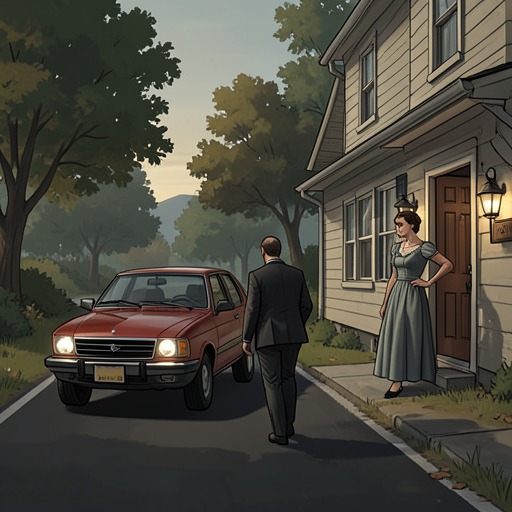
After the church service, Bunny Junior hears his father reassure him and feels better, though he can hear irritation in Bunny’s voice, directed, it seems, at the world rather than at him. They get out of the Punto and walk down a gravel path to the people gathered around Libby’s grave. The boy tries to listen to the vicar, but cannot make out what is being said, and two squabbling seagulls distract him. His attention moves between the burial and immediate, unsettling details: the sounds around him, his discomfort, and his difficulty concentrating. For him, the rite is not a clear explanation of death but an experience he can only partly follow.
When the burial prayers are finished, Father Miles looks toward Bunny, apparently expecting him to take part. Bunny goes to the grave, picks up a handful of earth, and drops it onto the lid of the simple mahogany coffin. The gesture is small and conventional, yet the narration marks its emotional consequence: as the earth falls, Bunny feels a kind of darkness spread over him. Geoffrey, Bunny’s employer, sits apart on a canvas folding stool, dabbing his face with a white handkerchief. Bunny thinks he may see tears on Geoffrey’s cheeks, but cannot be sure. The uncertain glimpse of another man’s grief contrasts with Bunny’s own sudden, inwardly felt darkness.
A request for help
The funeral also brings Bunny to an admission he has been unable to make. He approaches Mrs Pennington, Libby’s mother, and asks for her help. The plan he had devised the previous night, while sleeping on a sofa rather than in the master bedroom, had seemed brilliant to him then; in front of the grieving family it now seems unworkable. Mrs Pennington answers with anger, stressing that her daughter lies dead in her grave and that Bunny is asking something of her. Bunny nevertheless persists. He apologizes, raises his hands in a gesture of surrender, and asks her to look after her grandson for a while.
His request becomes more than a temporary arrangement when he admits that he cannot do it and does not know how. Mrs Pennington responds that the boy has only him, invoking Bunny’s imposing public identity even as he confesses his inability to manage fatherhood alone. The exchange makes the funeral a turning point in the surviving family’s immediate circumstances: Libby’s death has left Bunny responsible for Bunny Junior, and Bunny recognizes that he may not be capable of carrying that responsibility without help. The request does not erase the conflict between him and Mrs Pennington, but it makes his dependence explicit at the place where the family is gathered to mourn.
Grief beyond the burial
The funeral’s significance continues in the different ways Bunny and Bunny Junior remain attached to Libby. Bunny Junior tries to preserve his mother by arranging memories as if they were exhibits in the Booth Museum. He can picture himself laughing on a swing in St Ann’s Well Gardens, but increasingly cannot recall who is pushing him. His mother’s image becomes a dissolving, incomplete figure in memory. The contrast between his remarkable store of factual knowledge and this fading personal recollection makes the loss concrete: facts about the world remain available to him while the face of the person he most wants to remember recedes.
At another point, in the Punto on Meeching Road in Newhaven, Bunny Junior waits for his mother to find him and senses her hand and the smell of her hand cream. He hears a voice tell him that he is the most luminous object in the universe. Later, mist gathers around the car and he sees Libby in her orange nightdress, sitting on a low wall and beckoning. He joins her, apologizes, and rests his head against her. These encounters belong to the continuing experience of bereavement, not to the funeral service itself; they show how the mother absent from the grave remains present in the child’s inner life.
Bunny’s own sense of Libby’s presence is more troubled. In a later vision, he sees her through a crowd and begs her to forgive him. When he asks whether she has been haunting him, she says she never haunted him, then flickers and disappears. That denial unsettles Bunny’s interpretation without diminishing the force of his longing. Read alongside Bunny Junior’s efforts to hold on to his mother, the funeral marks the beginning of no simple separation: the coffin is buried, but the dead remain active in memory, guilt, and visions. Its decisive consequence is to expose both the practical fragility of the father left behind and the distinct ways father and son continue to seek Libby.